
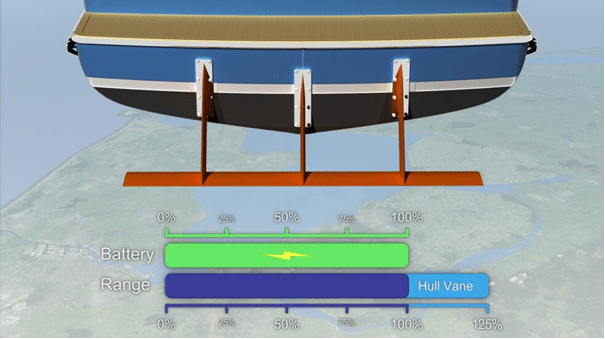
We believe that the transition toward electrically powered vessels will increasingly depend on hydrodynamic efficiency as a primary driver of operational range and energy demand. For displacement and semi-displacement hull forms, even modest reductions in total resistance can have a direct and measurable impact on battery sizing, range capability, and installed propulsion power.
Hull Vane® is a submerged hydrofoil mounted aft of the transom, designed to interact with the vessel’s stern wave system. By generating lift and modifying the pressure distribution at the aft body, it reduces wave-making resistance and recovers part of the wave energy as forward thrust. This mechanism leads to a reduction in total resistance that is particularly relevant in the medium-to-high Froude number range typical of fast patrol vessels and motor yachts.
For electrically powered vessels, reductions in total resistance translate directly into lower propulsion power demand at a given speed, and therefore increased operational range or reduced required energy storage capacity.
Sea trial results on two plug-in hybrid patrol vessels operated by the Port of Antwerp demonstrate significant reductions in delivered power across the operational speed range. Relative to the baseline hulls without Hull Vane®, the following results were measured:
- 25% reduction in required power at 10.8 knots
- 29% reduction in required power at 14.6 knots
- 22% reduction in required power at 18.9 knots
These results indicate a clear speed-dependent performance trend, consistent with the hydrodynamic interaction between the Hull Vane® and the vessel’s wave system. The highest relative benefit occurs in the mid-speed regime, where wave-making resistance is a dominant component of total resistance.
It should be emphasized that performance gains are vessel-specific and dependent on hull form, displacement, trim condition, and propulsion configuration. The Hull Vane® is therefore best evaluated as part of an integrated hull–propulsor optimization process rather than as an isolated retrofit component.
For electric and hybrid vessels, the observed reductions in delivered power directly translate into increased range for a given battery capacity, or alternatively reduced required installed energy for a specified operational profile.