
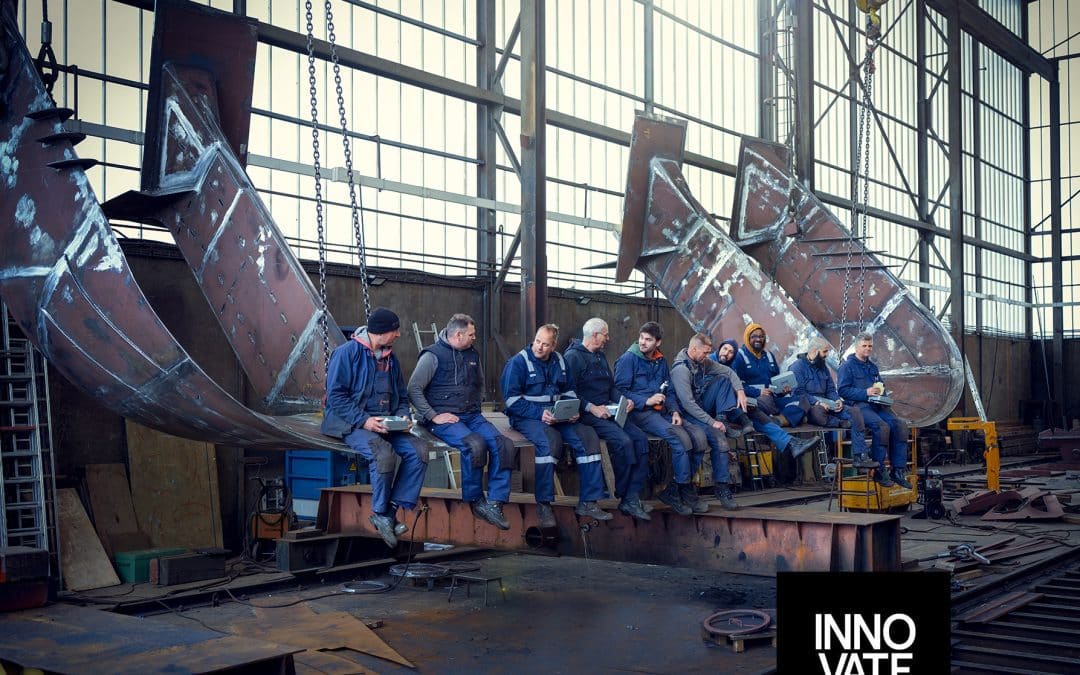
In an industry that spent decades optimising propellers while accepting wake energy as an unavoidable loss, Hull Vane took a different approach. The question was simple: why fight your own wake?
The answer lies in a fixed hydrofoil positioned beneath the stern, designed to reduce wave-making resistance, generate forward thrust and improve vessel trim. What began as an unrequested innovation has since developed into a proven solution for fuel efficiency and emissions reduction in maritime operations.
Innovation before market demand
“Hull Vane didn’t emerge because the market asked for it,” explains Niels Moerke, CEO of Hull Vane BV and Director at Van Oossanen Naval Architects. “It emerged because we recognized the potential in hydrodynamics and were committed to realizing it.”
This principle of leading ahead of explicit demand remains central to the company’s approach. In an interview with Innovate Magazine, Moerke described the nature of true market leadership: “Whoever waits until demand is explicitly stated is, by definition, too late.”
Proving it in practice
The early years required conviction. Unlike technologies driven by regulation or formal customer demand, Hull Vane had to demonstrate why a submerged wing could outperform established assumptions.
Validation came through iterative design, sea trials and long-term operational data. Today, with nearly 100 vessels equipped across more than 12 countries, the results are consistent:
- 5–15% fuel savings, depending on vessel type and operational profile
- No active crew involvement required
- Retrofit capability with limited cost and technical complexity
- No impact on draft, beam, length or dynamic positioning performance
Ecosystem and partnership
Sustaining innovation beyond the concept phase requires more than engineering. Hull Vane’s development has been supported by strategic legal and commercial partnerships, including collaboration with De Kempenaer Advocaten. This has enabled the company to address intellectual property, international liability frameworks and scalable licensing structures.
“Legal support in innovation is about enabling movement, not restricting it,” says Erik Duinkerke of De Kempenaer. “You need to understand the objective and determine how to achieve it responsibly, creating space within clear frameworks.”
This approach facilitated the 2024 licensing agreement with Malaysia’s Hayat Lestari Holdings, establishing local manufacturing capabilities and expanding access to naval, coastguard and commercial markets across Southeast Asia.
The road ahead
With the 100th unit ordered and adoption continuing to grow across a wide range of vessel types and international markets, Hull Vane® has evolved from a pioneering concept into a proven operational solution.
Yet the underlying philosophy remains unchanged. As Moerke puts it: “Leading doesn’t mean you know everything for certain. It means daring to question and move forward while others stand still.”